The clock ticks
Famesh Patel. 9/7/2020
The scientists who engaged in the Manhattan Project, a major project that was meant to create the first arsenal of nuclear bombs, started publishing a magazine by the name of Bulletin of Atomic Scientists under the liaison of the Chicago Atomic Scientists. This bunch included the likes of Enrico Fermi and J. Robert Oppenheimer.
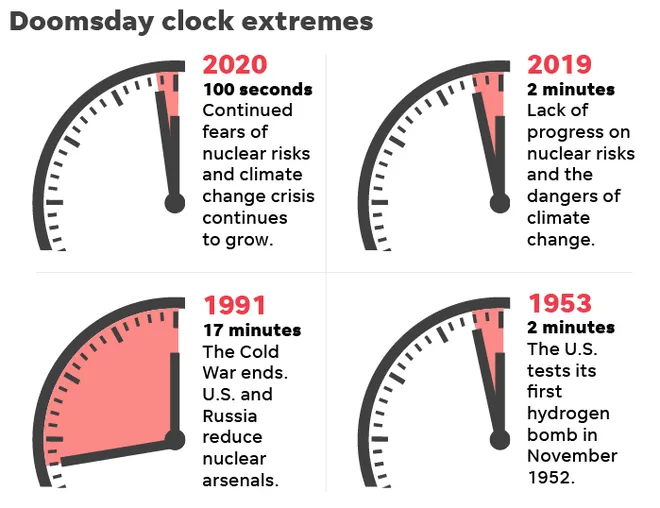
The first issue of the Bulletin included a clock in the background with the time set to 7 minutes before midnight. This clock wasn’t any other ordinary clock. According to Aperture, it represented “utter anthropogenic global catastrophe.” The clock represents how close we are to the total obliteration of the world by the hands of mankind. However, the minute hand can go forward or backwards depending on the situation. Ever since that first issue of the Bulletin, the clock has changed multiple times and relies on many factors such as climate change, pandemics or nuclear tension between nations. In 1947, the first year that the Bulletin of the Atomic Scientists was published, the clock was at 7 minutes to midnight. In 1972, it was 12 minutes to midnight and in 2018, 2 minutes from midnight. Now, you may ask, “How far are we from midnight in 2020?” We aren’t 20 minutes, not 10 minutes, not even 5 minutes away. We are a mere 100 seconds away from midnight. Just 1 minute and 40 seconds away from total global obliteration. Let that sink in.
When we talk about global obliteration, we usually think of nuclear bombs, asteroids or some sort of large scale explosion. When we measure these explosions, we usually talk about their destructive power through how much TNT is needed to produce an equivalent amount of destruction. At the time of the creation of the Doomsday clock, the two most powerful bombs in existence at the time were Fat Man and Little Boy, the infamous bombs dropped on Nagasaki and Hiroshima respectively. According to Beyond the Bomb, they also respectively had 21 kilotons and 15 kilotons of TNT force in them. However, the frightening thing is that they never actually reached their full potential.
When Fat Man was detonated on Nagasaki, only 1 kilogram (kg) out of the 6.5 kgs of plutonium actually fissioned, which is about 16%. And less than 1 kg of the 64 kgs of uranium in Little Boy actually fissioned, which is barely above 1%. Even though these nuclear weapons never exploded to their full potential, 2 combined kilograms of plutonium and uranium were able to wipe out 200,000 people. That was in 1945. About 75 years later in 2020, more than 125,000 nuclear weapons, which are far worse than Fat Man and Little Boy’s combined potential at 100% fission rate, have been created globally.
According to Britannica, in 1961, the USSR detonated the Tsar Bomba, the greatest hydrogen bomb to ever be tested, over the Siberian Wilderness. The bomb didn’t have 15,000 or even 20,000 tons of TNT power. It had 50 million tons of TNT power. It was so powerful that buildings that were 1,000 km away from the blast site saw broken windows from the shockwave. The shockwave circled the earth 3 times before it finally weakened and died out. The Tsar Bomba was originally going to be made into a 100 million ton monster, but that was decided against because it could have led the world into a nuclear winter. If 10 Tsar Bombas were blasted on the 10 most populated cities in the world today, we would have 106,200,000 casualties, more than all the casualties from every war in the 20th century combined. Right now, there are a whopping 13,410 nuclear weapons on standby according to the Federation of American Scientists. If one of these bombs is used, then all of them will be used. In an idea called mutually assured destruction (MAD), if a conflict between nations is pushed to the point that nuclear weapons are used, a nation will not hold back on their use of nuclear weapons at all so they can win the battle. The fallout from nuclear weapons being used in a war between just two countries with a decent nuclear arsenal could be so bad that it could lead to global extinction of the human race. Just one percent of the nuclear arsenal (200 nuclear bombs) of the world could cause over a billion deaths, according to Aperture.
There was a survey done on a group of scientists on extinction events by the year 2100, by the Global Catastrophic Risk Conference in 2008. This survey concluded that the probability of complete extinction by nuclear warfare was put at one percent. Only a 1 in a 100 chance, right? That’s small, so we should be fine. However, consider this: the chances of you dying in an airplane crash is 1 in 11 million, and dying by a lightning strike is 1 in 84,000. The probability of you dying because of nuclear warfare is the third most likely thing on the list of things that could kill you (right behind cancer and heart disease if you’re curious). Think about that.
If the two most loaded nuclear nations, the United States and Russia, went to war against each other, then that would basically mean the end of humanity as we know it. Both countries own about 93 percent of the global nuclear arsenal. A war of this magnitude and scale wouldn’t even be to win, but would be to make sure you don’t lose. The only way to do that would be to wipe the other country off the face of the earth. After these two countries start a nuclear war, there is no end. This type of war has no pause or redo button. It would only end once all of humanity ceases to exist.
Now think about it. If a nuclear war does start at all, is there any point in trying to survive? Our livelihoods and entire realities would be altered on such a large scale that life might not even be worth living after such a drastic event. Truly, the best way to win this game of nuclear prowess is to not even start playing because if you do, the clock might tip over midnight.
Cover Photo: (Flickr / El_Enigma)

Famesh is a senior at BASIS Peoria High School who enjoys all parts of science. Explaining the world around us with science has always seemed interesting to him from metamorphosis to the Higgs Boson. He hopes to help bring more youth to STEM fields so they can understand the natural world around us and appreciate the world for its uniqueness.